 Armenian resolution debates in US have turned into a kind of business Armenian resolution debates in US have turned into a kind of business
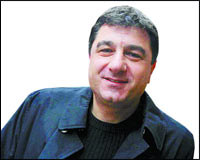
The Turkish co-president of the Turkish-Armenian Business Development Council (TABDC), Kaan Soyak, has asserted that debates over the Armenian resolution in the US Congress have turned into a kind of industry and that groups earning large amounts of money from this business are exerting serious efforts to ensure the problems continue.
Soyak, noting that the re-opening of the Armenian Akhtamar church in Lake Van would lead to developments in Turkish-Armenian trade relations, also asserted that the Turkish government needs to better explain some of the investments it has made in the name of trying to come up with solutions to the ongoing problems.
Soyak, who works as a consultant on the Middle East for US security firms and who has been a frequent traveler between Turkey and Armenia, made a series of striking statements to Today’s Zaman about Turkish-US relations and about the “Armenian genocide resolution” before the US Congress. “If the resolution passes, it will harm both countries. Groups who don’t want to see reconciliation between Turkey and Armenia are keeping this subject on the agenda. The events that have thus far occurred have turned into an industry of sorts. There are great numbers of books, films and projects related to this subject. Both societies have formed organizations focusing on this issue that raise and collect funds. There is a diaspora that has created its identity out of the Armenian problem. This resolution is necessary for this community to stay alive. The passage of this resolution is necessary for them to carry on with their lives. I have been visiting Armenia now for the past 10 years. Armenia’s priority is not the passage of this resolution. Armenia’s priority is to open up the border crossing, but the diaspora won’t even mention this. Third parties who don’t even have a connection to this business are making money from it. Whenever the Armenian question rises to the agenda, certain people come knocking at Turkey’s door, trying to take advantage of certain subjects,” Soyak said.
Soyak pointed to the fact that Armenia itself has made no attempts to get the resolution before the US Congress passed, noting that this is a sign of how tied Armenia’s economic structure is to the existence of the diaspora. “They cannot say ‘no’ to the resolution because their economy is tied to a large extent to the outside world. It’s also important not to forget the large flow of money out of California and the Russia factor, too. Up until today Armenia has not been involved in any sort of effort to see this resolution passed. There aren’t even any Armenian officials who come here to lobby. If Turkey could reach an agreement with Armenia, Armenia could tell the diaspora not to get involved in the matter and say, ‘We are straightening out our relations.’ As for the diaspora, it has a need for Armenia. For Turkey to say it finally agrees with Armenia would mean that the diaspora’s most important point of solidarity would be erased. Which is why the diaspora wants to see the borders closed and for there to be no agreements made,” he stated.
While the Armenian diaspora has for years and years used the advantage of being in the US, the rising numbers in the Turkish population mean that it too will soon be a powerful entity in the US, Soyak noted. He also spoke about the considerable number of Turkish-US and Armenian-US friendship groups in the US Congress and then went on to make this unorthodox suggestion: “There are around 70 members of Congress in the Turkish-US friendship group, and around 170 congressment in the Armenian-US friendship group. If these 240 people could only come together, they could carry through on some serious work. This would also mean the possible passage of all sorts of decisions through Congress. There could in particular be some major steps in the textile sector. Turkey would be able to sell products without being limited by any quotas. It would also be possible to use Armenia’s experience in the textile trade. What the coming together of these two groups would form would be an Anatolian-US friendship group.”
He also mentioned the slogans shouted by crowds during the funeral proceedings for slain Turkish-Armenian journalist Hrant Dink, noting that the controversial “We are all Armenians” was a significant gesture by the people. Soyak added that he could not understand the problems now between the two societies. He explained that he had participated in the New York ceremonies in memory of Dink, saying that there had been a remembrance service at an Armenian church on 35th Avenue on the 40th day after his death. He recalled: “I was the only Turkish person attending the program. It was a ceremony that included images from Dink’s funeral in İstanbul, when people were shouting slogans; there was also halva passed around. There are no other Christian groups that pass out halva after a funeral. I do not understand how two societies which so resemble each other could have so many problems.”
Soyak also spoke about how he watched the Turkey-Brazil match in the Armenian capital and related an interesting experience from that day: “I watched the Turkey-Brazil match in Yerevan. At the hotel I was staying in, the foreign diplomats were all supporting Brazil. As for the Armenians, they wanted the Turks to win. I passed out Turkish T-shirts I had with me to the Armenians watching the match. Everyone put on their T-shirts, and starting yelling ‘Turkey!’”
The earthquake disaster Turkey experienced in 1999 brought the two countries’ relations closer together, said Soyak. “The first offer of help after the 1999 earthquake came from Armenia. Armenia was going to send an airplane full of personnel and rescue assistance. The government we had at the time rejected this assistance. At that point the military’s General Staff got involved and arranged for the aid from Armenia to be sent. At the same time Turkish citizens living in the US carried out an assistance campaign to help those affected by the earthquake in Turkey, raising $600,000. But ethnically Armenian US citizen Kirk Kerkorian on his own donated $1 million to the earthquake disaster. The Turkish ambassador in Washington at that time knew about this. The assistance was sent through the Red Cross,” he noted.
Soyak noted that while he has found recent efforts by the Turkish government with regards to bettering relations with Armenia positive, he still thinks Ankara needs to learn how to explain more clearly what steps it is taking. The business points to places like Akdamar Island in Van Like and Ani near the Armenian border as places critical for the development of not only dialogue but trade. If Turkey’s trade relations with Armenia increased, asserted Soyak, all the other problems would also be easier to deal with. “At this point, we have an annual $100 million worth of trade with Armenia. If the borders were opened up, this would climb to $400 million annually, and it would contribute much to bilateral relations,” he said.
He also spoke about a group trip made by 150 Armenians to Turkey in 2001 and how this group all went to Lake Van, filled plastic bottles with water from the lake and took them back to the US. He noted: “We asked 250 people coming to Armenia from the Armenian diaspora, ‘If the borders with Turkey were open today, would you want to go to places like Akdamar and Ani?’ Everyone answered ‘yes.’ I heard straight from the mouth of Alparslan Turkes, ‘When the Turks arrived in Anatolia in 1071, the Armenians took them in and together they fought against the soldiers from the Roman Empire’.”
Soyak said his organization has seen support from every faction and that they base their views as being against anything which creates problems between Turkey and Armenia. “We don’t have any political beliefs as an organization. When we come together with our Armenian members, we don’t discuss history. There is a need for reconciliation and for these two peoples to get to know each other better. Turkey is a great nation. Great nations make gestures. Opening up the borders with Armenia would be one such gesture. Since Turkey is such a large nation, it could clarify the conditions under which it would do this.”
——————————————————————————–
[PROFILE]
Who is Kaan Soyak?
Co-president of the Turkish-Armenian Business Development Council (TABDC), Kaan Soyak was born in 1961. Founder and partner in Alyans-Tempo Shipping and Seafaring Company, he is also a consultant for a variety of US security firms in the Middle East, as well as a member of the Latin American and Caribbean Security Council Board. After the break-up of the Soviet Union, Soyak organized the delivery of the first humanitarian aid shipments made by the US to countries in Central Asia and the Caucasus. He also set up the first Turkish-Russian partner firm and brought the first Russian capital investment into Turkey. He has been working on Turkish-Armenian relations since 1996. He took key role in starting up relations between Yerevan and Ankara after Armenia’s independence and also in helping organize the first meetings between members of the Armenian diaspora and the Turkish government. Soyak has been credited by both the Turkish and the Yerevan administrations for being someone to help relations between both countries and their people. He also bridged ties between the US-based TABDC-US and the Europe-based TABDC-EU. Soyak is a graduate of the Middle East Technical University’s (ODTÜ) International Relations Department.
15.04.2007
MEHMET DEMİRCİ NEW YORK
News Source: Sundays Zaman |



 Akgün Medya